


The American Lawn: An Accidental Foundation for a Wildlife Corridor?
How America's obsession with the perfect residential lawn may have created one of its greatest opportunities for ecological restoration.
America's obsession with the perfect residential lawn has long been criticised for its environmental consequences. And rightly so: extensive turfgrass monocultures, intensive mowing, fertiliser applications and irrigation can have considerable environmental costs. But there is another side to the American residential landscape that deserves attention. The country's preference for detached homes, generous setbacks, front lawns and backyards has created an enormous amount of privately owned outdoor space. What if that space, rather than being viewed exclusively as an environmental liability, represents one of America's greatest opportunities for biodiversity restoration?

An extraordinary amount of land
Milesi et al. (2005), in a study published in Environmental Management, estimated that turfgrass covered approximately 163,800 km² of the contiguous United States, an area three times greater than any individual irrigated crop. That is an extraordinary amount of land devoted to grass.
More importantly, Lerman et al. (2023), in their BioScience paper, 'Humanity for Habitat: Residential Yards as an Opportunity for Biodiversity Conservation', estimated that single-family residential properties and their associated yards occupy approximately 30% of the contiguous United States. Their analysis identified an estimated 130 million residential yards, representing a potentially enormous opportunity to support biodiversity through changes in everyday landscape management.
There is an interesting international comparison here. The researchers cited estimates suggesting that residential yards account for approximately 2% of the UK's total land area, compared with approximately 30% of the contiguous United States. This difference is partly explained by the much larger average size of American residential properties. These figures are not a direct comparison of natural vegetation or total green-space cover, but they demonstrate just how significant the American residential landscape is as a potential conservation resource.
Accessibility to public green space provides another useful comparison. Kaufmann et al. (2025), in npj Urban Sustainability, compared park accessibility across almost 500 metropolitan areas in six countries: the United States, France, Sweden, Estonia, Greece and Mexico. They found that almost one in two people living in American metropolitan areas could not reach a park within a ten-minute walk. The equivalent figure was approximately one in three in France, one in four in Sweden and Estonia, and one in five in Greece. Atlanta had a median walking time of approximately 24 minutes to the nearest park.
This is an important distinction. Private gardens cannot replace public parks, but where access to public green space is limited, residential properties represent another opportunity to introduce vegetation, habitat and ecological function into the built environment.
When individual gardens become a collective resource
The ecological value of residential gardens becomes particularly interesting when we stop considering properties individually and start looking at entire neighbourhoods.
Belaire, Whelan and Minor (2014), studying residential neighbourhoods in Chicago, found that the combined characteristics of neighbouring gardens were more important in explaining native bird species richness than broader neighbourhood or landscape characteristics. Properties containing trees and fruit- and berry-producing plants contributed positively to native bird diversity. Their research provides compelling evidence that individual gardening decisions can have cumulative ecological consequences.

Lynch (2021), in The Role and Potential of Residential Open Space in a Suburban Green Space Network, examined more than 1,900 residential open-space parcels in Montgomery County, Pennsylvania. The study found that residential open spaces were clustered at an average separation of approximately 163 metres, and that their inclusion increased the mean patch size of conservation lands by 18.5%. This demonstrates the potential for residential properties to contribute to the configuration and connectivity of wider green-space networks.
Other research has demonstrated that these spaces can support wildlife beyond birds. Johansson and DeGregorio (2024), studying residential yards in Northwest Arkansas, found that garden area was positively associated with mammalian herbivore richness, while surrounding forest cover influenced mammal diversity. Larson et al. (2022) also examined the potential to expand wildlife-supporting residential yards, identifying both opportunities and barriers to homeowners adopting more biodiversity-friendly landscaping.
No, you don't have to kill your lawn.... lawn reductions are just fine
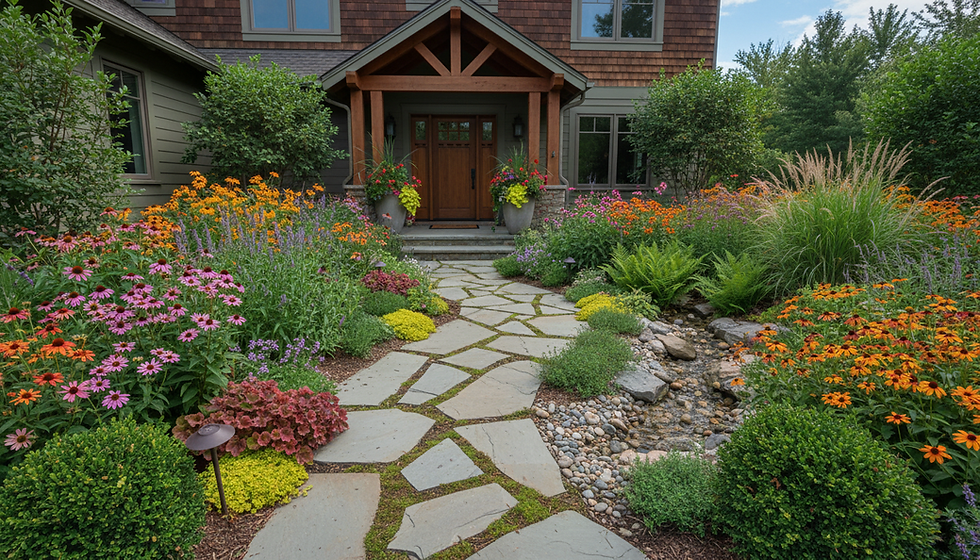
Perhaps the biggest obstacle to encouraging ecological landscaping is the perception that homeowners must choose between an attractive, usable lawn and a wildlife-friendly garden. This is a false choice. There is nothing inherently wrong with retaining turfgrass for children, pets, entertaining or recreation. The objective should not be to eliminate every lawn, but to reconsider how much space needs to be devoted to it. Start small. Island borders, foundation borders, even small mailbox plantings make a difference.

Research by Lerman et al. (2021), examining residential landscapes across six American metropolitan areas, found that yard management and surrounding tree canopy and impervious surface cover influenced bird community diversity. Wildlife-supporting yards supported more heterogeneous bird communities than conventional lawn-dominated properties. Padullés Cubino et al. (2020) similarly found that wildlife-certified yards were functionally more similar to natural areas than lawn-dominated properties, although all residential yard types remained more functionally homogeneous than natural ecosystems.
A reduction in lawn area is a perfectly reasonable starting point. Converting a sunny section into flowering perennials and grasses, planting native shrubs along a property boundary, introducing woodland groundcover beneath existing trees or simply allowing a larger planting bed to develop can all increase habitat diversity. The important thing is to introduce more vegetation structure, flowering resources, food and shelter.
A national movement, one garden at a time
One initiative making this collective approach visible is Homegrown National Park, founded by ecologist Doug Tallamy. Its Biodiversity Map allows individuals, businesses, schools and community organisations to register native planting projects and see the cumulative contribution of habitat restoration across the country. The concept is wonderfully simple: rather than waiting for governments to create more protected land, people can begin restoring biodiversity in the spaces they already manage. The map also helps people discover local native plant organisations, nurseries, landscapers and community projects.

Getting involved is free. Visit Homegrown National Park's Biodiversity Map, create an account and register your planting areas, including their approximate size, location and planting date. You can also explore existing projects without registering. It is an opportunity to make individual efforts visible and connect them to a much larger movement.
Perhaps the lawn deserves some credit
American residential development has undoubtedly displaced natural ecosystems and contributed to habitat fragmentation. Residential gardens will never replace the protection of intact forests, wetlands, grasslands, and other natural habitats. But the enormous amount of privately owned outdoor space already present in the American landscape represents an fantastic opportunity that we should'nt overlook.
The detached-home architecture, generous setbacks and residential lawns that helped define suburban America also created the physical space for millions of potential wildlife gardens. We already have the land. We already have the neighbourhoods. What we need is a shift in how we use that space. We do not need every homeowner to remove their lawn. We simply need to recognise that a portion of that space could be doing more.

If millions of properties each make relatively modest changes, the cumulative result could be a substantial network of wildlife-supporting landscapes, linking residential gardens with parks, woodlands, waterways and remaining natural habitats.
Perhaps America's obsession with the lawn inadvertently created the opportunity for one of its greatest ecological restoration movements. We don't have to kill the lawn. We just have to give a little more of that space back to nature.
WORKS CITED 1. Milesi, C. et al. (2005) 'Mapping and modeling the biogeochemical cycling of turf grasses in the United States', Environmental Management, 36, pp. 426–438. https://doi.org/10.1007/s00267-004-0316-2.
2. Lerman, S.B. et al. (2023) 'Humanity for Habitat: Residential Yards as an Opportunity for Biodiversity Conservation', BioScience, 73(9), pp. 671–689. https://doi.org/10.1093/biosci/biad085.
3. Kaufmann, T. et al. (2025) 'Variation in access to urban parks across six OECD countries', npj Urban Sustainability, 5, article 40. https://doi.org/10.1038/s42949-025-00212-0.
4. Belaire, J.A., Whelan, C.J. and Minor, E.S. (2014) 'Having our yards and sharing them too: the collective effects of yards on native bird species in an urban landscape', Ecological Applications, 24(8), pp. 2132–2143. https://doi.org/10.1890/13-2259.1.
5. Lynch, A.J. (2021) 'The role and potential of residential open space in a suburban green space network', Urban Forestry & Urban Greening, 58, 126971. https://doi.org/10.1016/j.ufug.2020.126971.
6. Lerman, S.B. et al. (2021) 'Residential yard management and landscape cover affect urban bird community diversity across the continental USA', Ecological Applications, 31(8), e02455. https://doi.org/10.1002/eap.2455.
7. Padullés Cubino, J. et al. (2020) 'Taxonomic, phylogenetic, and functional composition and homogenization of residential yard vegetation with contrasting management', Landscape and Urban Planning, 202, 103877. https://doi.org/10.1016/j.landurbplan.2020.103877.
8. Lerman, S.B. and Milam, J. (2016) 'Bee fauna and floral abundance within lawn-dominated suburban yards in Springfield, MA', Annals of the Entomological Society of America, 109(5), pp. 713–723. https://doi.org/10.1093/aesa/saw043.
9. Larson, K.L. et al. (2022) 'Examining the potential to expand wildlife-supporting residential yards and gardens', Landscape and Urban Planning, 222, 104396. https://doi.org/10.1016/j.landurbplan.2022.104396.
10. Johansson, E.P. and DeGregorio, B.A. (2024) 'The effects of landscape and yard features on mammal diversity in residential yards within Northwest Arkansas, USA', Urban Ecosystems, 27, pp. 275–287. https://doi.org/10.1007/s11252-023-01433-w.


Comments